
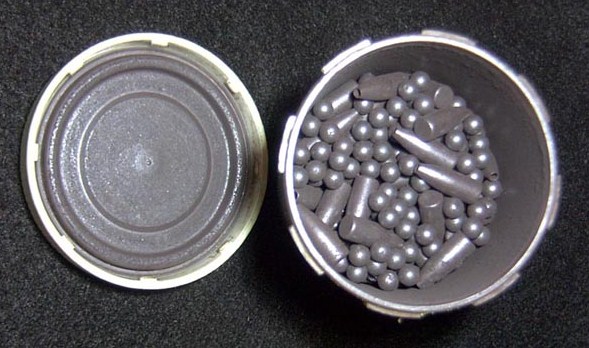
| Coated bullets have grown in popularity but do they really extend barrel life and by how much? Molybdenum disulfide and a protective layer of wax is the common treatment. There’s also a small but growing use of Hex-Boron Nitride. Norma was at the forefront of this trend and published some of the earliest lab tests. Since then guys like David Tubbs have done a lot to promote its use competitive shooting. They determined: |
- Friction is reduced
- Pressure is decreased by 3 – 6% depending on the components
- Lower pressure means lower velocity; the trade-off is normally 1 -2%
- For a set pressure, higher speeds are attained
- There’s no adverse effect on rifling. In fact most evidence suggests it
increases longevity - Less jacket fouling
- No statistically significant impact on accuracy

 |
 |
| We’re still learning about the benefits, and limitations, of molybdenum in a few key areas. To what degree is barrel life is extended? Does moly lower barrel temperatures, thus slowing metal erosion? Is in-flight trajectory improved? Fair questions and in controlled environments we’ll hopefully get answers. I believe coating bullets does extend barrel life but cannot say by how much. Ballisticians have tried to quantify the gain and the results are scattered. With so many variables to consider it’s hard to draw strong correlations between bullet treatments and wear resistance. The low end suggest a 3% improvement, big moly proponents claim 20%. So why did I drag you through all that? In order to understand barrel life and maintenance we need to know why they go away. This applies to any cartridge, not just screamers like the .224 Clark. Having spent a lot of time in the over-bore arena I can categorically say this: There’s no substitute for shot spacing and frequent cleaning. Moly and lower flame temp super powders help but they can't replace common sense. Let the barrel cool after every 4 or 5 shots and clean after every 10 – 15. Volumes can be written about cleaning technique. Bronze versus nylon brushes, the top solvents for removing copper fouling, single or bi-directional rod strokes, etc, etc. Inevitably these debates end with the bore-scope and no absolute best way to clean a barrel. Some processes are better than others however so I’ll share one that works for me: |

- Push one heavily soaked patch of Kroil down the bore
- 4 wet patches of Butch's Bore Shine. Push out, don't pull back.
- Bronze brush - 1.5 strokes per shot. Pull back but be careful on the
crown. Rewet brush every 4 passes - Push 4 wet patches of Butch's. Let that sit for 15 minutes
- Then 4 dry patches. Check color. Green/blue indicates copper
- Lastly, run a lightly oiled Kroil patch through
- If you still feel roughness on the stroke use JB Red Rogue on a jagged
patch
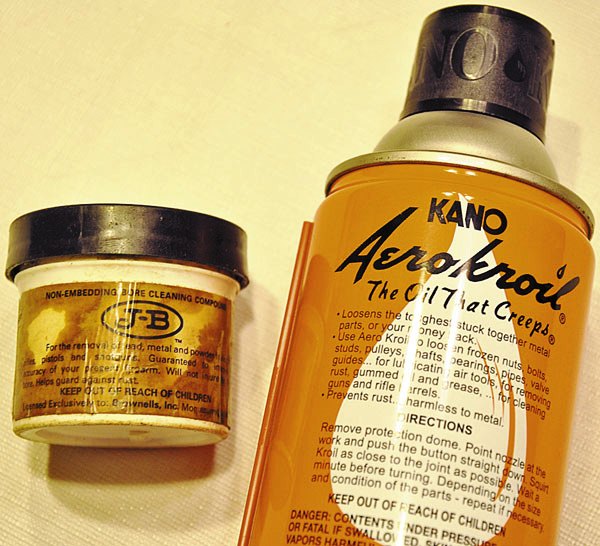
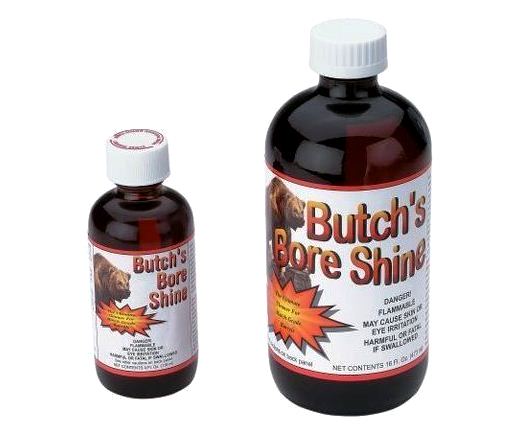
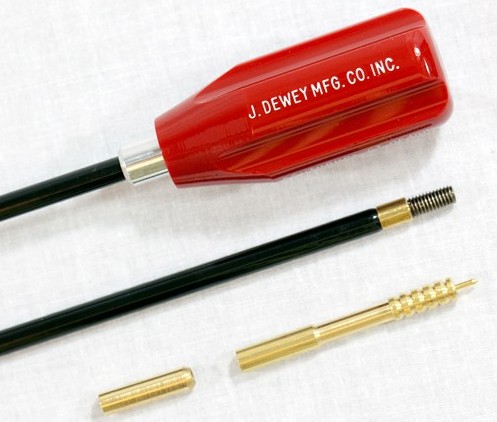
| Never clean without a bore guide and I also recommend using coated rods. Dewey and MTX are top brands and both reduce the risk of land damage. You'll see my solvent approach is two-pronged. I start with Kroil which is penetrating oil. It removes powder residue and loosens bullet fouling in prep for stronger solvents. I like Butch’s Bore Shine on copper but Witches Brew, Shooters Choice, and Montana X-treme work just as well. The late Butch Fisher developed Bore Shine in the 1990’s and it took benchrest by storm. While high in ammonia content it is non-abrasive. For the best results just be sure to let it sit for 10 to 15 minutes post-brushing. |
 |
 |
| Alright, we're close to putting our heal to the steel with this .224 Clark. We know what the barrel will be subjected to, the sort of speeds to expect, and the appropriate fuels. A cleaning regiment is also in place. And the load levels? Nothing but wide-open with this wildcat. If I wanted a .22-250 I would have hit the gun store and bought one. You don't build nitro dragsters to idle around town do you? Nor do you build .224 Clarks to mimic the Swift. Sandbagging on powder will stretch barrels but that defeats the purpose of this heavyweight 22. Besides, my reamer is good for more than one chamber and I have Shilen's number in my phone. But how quick will my barrel die? The answer may surprise you. Years ago a gentleman, who’s name escapes me, created the overbore index. It is basically a comparative measure of powder capacity to bore diameter. The calculation is quite simple. Take the internal volume in grains of water and divide by the bore diameter in inches. Example – a .30-06 holds 68.2 grains of water and the bore area equals 0.0745 inches ((0.308/2)^2) x pi). That nets an index of 915.2. Comparatively speaking a .222 Remington indexes at 685.1 and a 7 Rem Mag is 1,325.8. The author deemed anything >1000 to be overbore, anything under isn’t. So where does the .224 Clark fall? 1,384.2 based on my Remington brass. Up there but it is only 6 - 8% more over-bore than the .25-06, 7mm Magnum, and .220 Swift. This index further ties into Accurate's barrel life formula. The derivation is involved but uses five inputs: 1) The bullet diameter, 2) Powder charge in grains, 3) The powder's heat potential (kJ/Kg), 4) Case pressure (PSI), and 5) Whether the bullet is moly coated (Y/N). The Clark's life expectancy? With 61.0 grains of US 869, 58,000 PSI, a heat potential of 3,710 kJ/KG, and non-moly pills barrel life is ~1,100. This aligns with what Clark and Simpson reported from their .224's. Understandably the model assumes proper shot spacing and thorough cleaning. One more side-bar then we'll get to the range. When Ross Seyfried built his 6mm Mach IV in the early 90's he reported nose-diving accuracy. Barrels usually start to fade over a few hundred rounds, not a couple dozen. Oddly his big 6mm bug-holed for the first 200 pulls then fanned around 250. He cleaned at 40 rounds, managed his intervals, and even bore-scoped. What could cause such a precipitous drop off? It was only after Pac Nor's Chris Dichter sectioned a barrel did they find the problem. Three inches past the chamber was a ceramic-like layer of carbon that couldn't be cut with a dental pick. This reinforces the need to clean every 15 rounds. Personally I find <=10 to be ideal. If you don't stay ahead of this carbon print you'll have to resort to hard abrasives (JB, Rem Clean, Flitz, etc). They'll de-carbon in a flash but also wear your lands. I'd like to get away with ammonia based so I plan to brush after 8 -10 shots. |

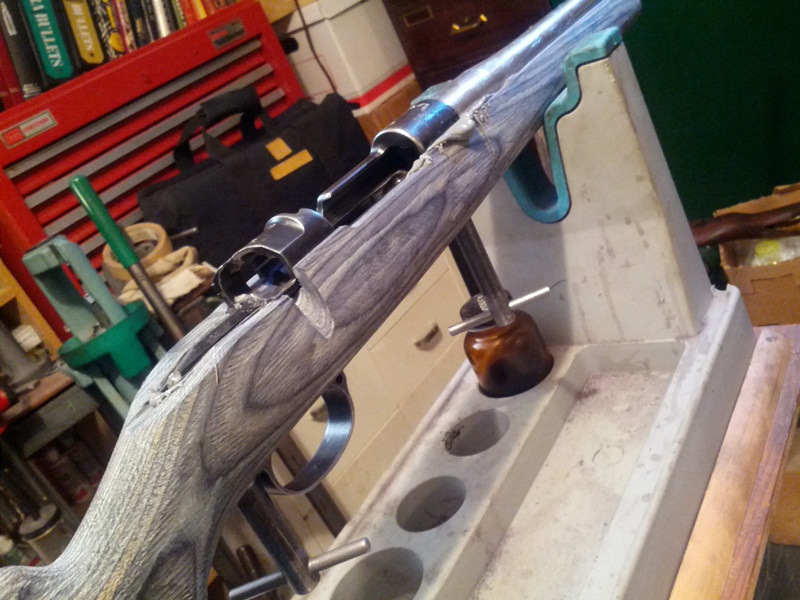
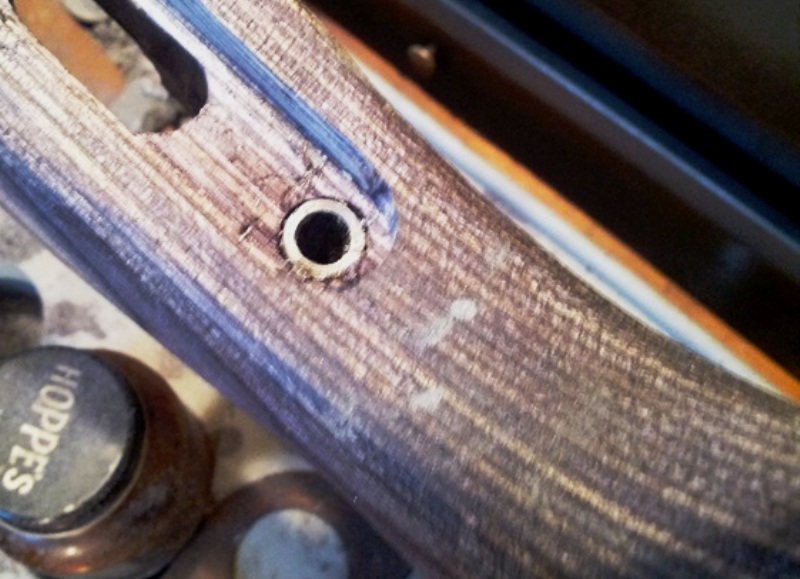
| To this point we had shot the gun just bolted to the inletted stock. We chose Devcon 10610 for bedding the recoil lug and barrel channel four inches past the main ring. The tang was also bedded with the back guard bolt shrouded in an aluminum pillar. |
 |


